

Revisiting the Philosophical Case for Bitcoin
An interview with the authors of Resistance Money: A Philosophical Case for Bitcoin


In the past decade, bitcoin has gone from being a relatively niche digital currency popular amongst cypherpunks and cybercriminals to a speculative asset with a market cap exceeding $2 trillion.
Much can be said about how this came to be. Bitcoin was invented in 2008 by an anonymous individual or collective going by the name Satoshi Nakamoto and is recognized as the first decentralized cryptocurrency. Borne out of a libertarian and cypherpunk ethos, many of its original proponents may see the rise of a regulated crypto industry with an oversized influence in Washington as a departure from its original vision. The crypto lobby became one of the biggest spenders in the 2024 elections, investing hundreds of millions of dollars in the campaigns of pro-crypto politicians.
Political and financial market leaders who once decried crypto as a scam have changed their tunes. Donald Trump, who said he was not a fan of cryptocurrencies and called bitcoin “highly volatile and based on thin air” during his first term, is now launching his own crypto projects and exploring establishing a ‘strategic bitcoin reserve’ for the United States.
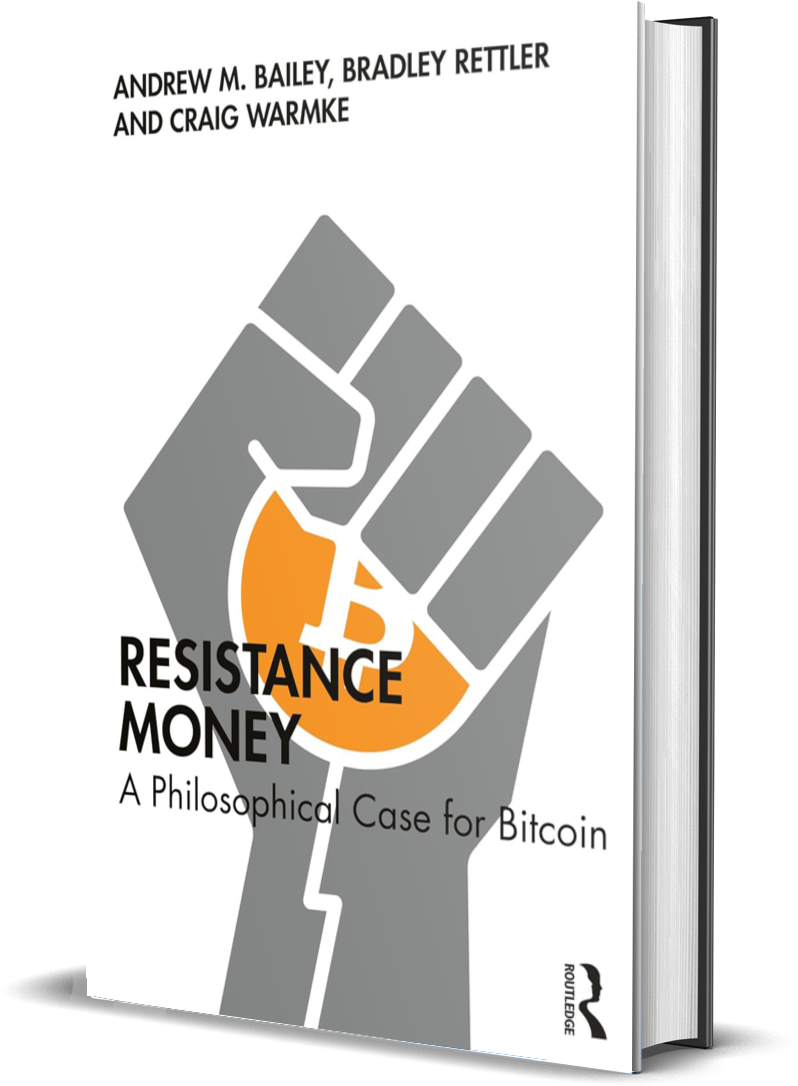
For someone who has been following cryptocurrencies since 2017, the mainstream adoption of a censorship-resistant, decentralized currency by America’s financial elite has been a fascinating evolution, one that coincides with the rise of populism in the United States and increasing gamification of regulated financial markets. It is against this backdrop that I wanted to speak with some of the few academic philosophers currently writing on the topic of bitcoin: Andrew M. Bailey, Bradley Rettler, and Craig Warmke, the authors of Resistance Money: The Philosophical Case for Bitcoin.
Resistance Money leverages the thought experiment the Veil of Ignorance – conceived by John Harsanyi and popularized by John Rawls – to explore the question: would you rather live in a world with or without bitcoin? Given that the book was published in June 2024, I wanted to understand if the rise in public and political interest in cryptocurrencies since Resistance Money’s publication has impacted their original analysis.
Could you provide a brief overview of the argument you presented in this book?
Everyone has heard of bitcoin by now, and many have opinions, despite knowing little about it. What’s more, bitcoin is a financial asset (you can own it, and profit or lose by doing so), making the topic ripe for biases – for or against.
You might want to know whether you should buy bitcoin, or whether it is good for you. Our work draws attention to a different question: is bitcoin good for the world? And to answer the question, we offer a framework for evaluating bitcoin that aims to remove personal biases and helps each reader reason for herself about whether bitcoin makes the world better. It can be expressed in this question: if you didn’t know who you’d be, would you want to wake up in a world with bitcoin or one without?
It’s a big question, and answering it responsibly requires thinking about bitcoin along a number of dimensions: inclusivity, censorship resistance, privacy, monetary policies and institutions, and environmental externalities. In the book, we collate the empirical and conceptual evidence necessary to do this work and argue that bitcoin makes the world better. You may not in fact suffer from bad monetary policies and institutions. But billions around the world do, and we think that if you didn’t know who you’d be, you’d want to wake up in a world with an option to use bitcoin, as a means of escaping those mismanaged monies. You may not in fact suffer from financial censorship. But billions around the world do — well-functioning liberal democracies are not the global norm, after all — and so we think you’d want to wake up in a world with access to censorship-resistant digital cash. That’s bitcoin.
Along the way, we present over twenty-five objections to bitcoin — some good, some bad, some comically bad and founded on pseudoscience — and evaluate them. Despite bitcoin’s imperfections and bad consequences, we argue that on the whole bitcoin is good for the world. If you didn’t know who you’d be, you’d want to wake up in a world with bitcoin in it.
For a more in depth look at the book’s arguments, see Bradley Rutter’s post for the Blog of the American Philosophical Association here.
As philosophers, how did you become interested in Bitcoin/cryptocurrencies?
We each found our own way to bitcoin, and then we found each other. It took years to become convinced that bitcoin was no mere flash in the pan, that it raised important questions, and that we had something to say about those questions. We began integrating bitcoin content into our classes, and then agreed to write a survey article for Philosophy Compass on the topic. 20,000 words and 500 sources later, we weren’t even close to being done. To give bitcoin the in-depth treatment it deserved, we had to write a book. So we wrote a book.
On a more personal note, though we didn’t quite know it at the time, each of us was looking for something more. Not more metaphysics, but something to write and think about that engaged the real world. Bitcoin fit the bill. Ordinary people care about the topic, and it lies at the intersection of several subfields of philosophy and the social sciences. Learning about all these things proved to be fun. It’s given our careers new life and joy. And through working on bitcoin, we’ve found new ways to serve our communities, engage public audiences, and even influence public policy.
Would you be able to share some examples of the ways you have engaged your communities and broader audiences?
One of us has taken it upon himself to give a bitcoin talk in every county in his state of Wyoming. Since the book was published, he’s hit four of 23 counties. Reactions have been positive, and our sense is that non-academic audiences are hungry for unbiased and informed information here. They want to think more about bitcoin, and academics can help.
Another of us regularly consults with lawmakers in Singapore, including multiple invited visits to the Prime Minister’s office, and has been quoted as a ‘crypto expert’ in the New York Times.
And the three of us, often together, regularly present our ideas to policy audiences in Washington, D.C., thanks to the support of the Bitcoin Policy Institute. That work has led to editorials in mainstream venues like USA Today, Barron’s, and Newsweek.
We’ve also made dozens of podcast appearances for non-academic audiences. Listeners are sometimes suspicious of philosophers or academics. But to our delight, we’ve found that they warm up quickly, and that thinking about these things the way philosophers do can be useful to ordinary people trying to figure out their world.
At a non-academic conference in the UK, for example, a fellow in the audience saw that three philosophers would be on stage next. “Dear lord, not philosophers”, he later told us was his thought. He left the room, hoping to use the facilities during our session. But the line was long. So he wandered back into the hall, and found himself listening to a panel discussion in which we walked through the veil of ignorance thought experiment and its relevance to bitcoin. To his surprise, he was hooked! We’re all buddies now. Thanks to that interaction, a retired plumber from Yorkshire read an academic book about bitcoin, found it to be good, and actually recommends it to his friends.
Chapter three of the book explores the question of what money should be – in your view, what functions should monies ideally serve?
To be money is to fill a certain role. Something is a money exactly to the extent that it is a generally accepted medium of exchange. Just about anything can be a money — cigarettes in a prison, for example. But which things should be used as money? Now there’s a question for a philosopher!
When explaining what makes for a good money, a standard economics textbook might list properties like scarcity, divisibility, portability, fungibility, verifiability, and durability. Our view is that these properties make for apt use as money. But not everything apt for use as money should be used as money. Take human teeth, for example. They are scarce, durable, portable, and so on. But, given the incentives, it is a very bad idea, morally speaking, to use human teeth as money. So, in addition to purely technical questions about usefulness, money raises normative questions.
Bitcoin prompts instances of these questions in pointed ways. Should bitcoin serve as money? In what respects does using bitcoin as money make the world better, or worse, and for whom? We cannot answer these questions without surveying both normative issues and empirical facts and weighing the trade-offs of censorship-resistance, fixed monetary policies, and so on.
Does the entry of major financial players into the market seeking to make a profit off Bitcoin’s price movement impact its utility as a resistance currency? On one hand, it seems the entry of institutional capital could help stabilize the market and reduce volatility. On the other, it also seems like an increase in known addresses and scrutiny of blockchain transactions by financial regulators could reduce its ability to offer anonymity in the long run.
Institutional adoption has costs and benefits. Some of the benefits include improved liquidity (it’s easier to trade bitcoin for some local currency, or to trade some local currency for bitcoin), credibility (fewer people treat bitcoin with suspicion), and protection of bitcoin from bad policies. Here’s an example. The Anti-Corruption Foundation accepts bitcoin donations and uses bitcoin as money because they, along with most dissidents, are barred from banking in Russia. Corporate adoption of bitcoin elsewhere in the world makes life easier for the Foundation — easier to solicit bitcoin donations, easier to spend the bitcoin they have, easier to do their work.
Another benefit of increased bitcoin adoption of any kind is enhanced privacy for users. Most bitcoin privacy tools work by way of obscurity: hiding in a crowd. The bigger the crowd, the easier it is to hide.
You’re right that institutional use of bitcoin comes with some surveillance, too. Users who get their bitcoin through centralized exchanges and who don’t use bitcoin privacy tools, for example, will have their addresses marked, and their transactions linked to real-world identities. So anyone who’d like to use bitcoin as resistance money should acquire it through other means — peer-to-peer cash transactions, for example — and use bitcoin privacy tools.
The US president has positioned himself as a champion of the digital assets industry. Does the exploitation of the cryptocurrency market by Trump have any impact on Bitcoin’s utility as resistance money?
No. It certainly impacts adoption in that it makes people who like Trump more likely to use it, and people who dislike Trump less likely to use it. But most people who use bitcoin as resistance money do so because they must. Declining to use bitcoin because Trump likes it would be like declining to use encrypted text messages because Pete Hegseth uses Signal. The argument betrays privilege, and marginalized people who seek refuge from surveillance won’t take it seriously.
In the final chapter you mention two possible futures for Bitcoin – either that users will move on from it and the network could slowly die, or it will continue to grow in its usefulness and strength. Do you still see these as the most likely possible two futures?
Yes. But the slow death path looks less likely than ever before. It was once reasonable to ask: will Christianity go to zero? But that time is gone. We suspect the same is true of bitcoin. Open questions remain, of course. And the future lies in the hands of actual users. Will they take self-custody, and use bitcoin as resistance money, or will they primarily use it as a speculative vehicle?
Another cluster of relevant questions concerns, not bitcoin’s users, but the forces around the world that make bitcoin useful in the first place. Will liberal democracies backslide? Will free expression take a hit across the next decade or three? Will authoritarianism continue to rise, and create demand for anti-authoritarian technologies? Affirmative answers to these questions predict a world in which bitcoin continues to flourish.
The creator of Tornado Cash, a privacy-preserving crypto mixer service, Roman Storm, was charged with money laundering and sanctions evasion under accusations that the service had been used by black-listed groups like the North Korean hackers, the Lazarus Group. Do you have a view on how liberal democratic governments should treat programs like Tornado Cash which indiscriminately provide financial privacy to users?
Tornado Cash, and similar privacy tools on the bitcoin network, are a net good for the world, for the same reason that physical cash is a net good for the world. Cash indiscriminately provides financial privacy to its users, within limits. You can buy a phone with cash, but not a house; and cash is heavy to carry around; and not all merchants accept cash. So also, cryptographic privacy services provide financial privacy to their users, within limits. For they, like cash, are subject to liquidity and acceptability constraints.
Liberal democracies should tolerate and even promote these tools just as they tolerate and promote physical cash. Doing so also means that we should not imprison developers who create privacy-enhancing tools in the digital realm. The price of freedom is that some people will use it for bad things. Our view? Pay it.
Your response here made me think about digital IDs, as there is a major push for their introduction in the UK right now. While the design of any digital ID program would matter significantly to assessing whether they are ultimately desirable or not, many people are strongly opposed to the idea due to privacy concerns. On the other side of the debate, others argue that digital IDs will make accessing public services more efficient and help the government identify those who are in the country illegally. Do you have a view on digital IDs in principle? What would you say to those who believe the benefits outweigh potential privacy concerns?
Centralized digital chokepoints — as when a corporate or state authority can shut off all user access to a network with the push of a button — are risky. The more digital our lives are, the greater the risks those chokepoints pose, including hacks, leaks, and authoritarian abuse. That latter risk is especially weighty. Your team may have power now, but another team may have it in the future. Systems that allow authorities to block access to banking, internet, and employment empower future authoritarians to enhance their control over the world. An authority may promise efficiency or security, but if she can block children entirely from certain websites, she can likely block anyone from any site. And authorities may do so for various reasons: because you disagree with them, or come from the wrong part of the world, or refuse to pay some other price they wish to extract.
The point is not that centralized chokepoints are always bad. It is that they come at a significant price, and responsible evaluation of their merits should take this into account. Doing without centralized chokepoints in favor of a neutral system that serves all – as bitcoin does – has a price of its own, of course. We think it is worth that price, for the same reason that liberals have always given: though freedom can be misused, it is itself a precious thing, and not to be given up lightly.
Thank you all for your time. It has been a pleasure revisiting your arguments and discussing bitcoin’s persisting value as a censorship-resistant and privacy-preserving form of money.
As cryptocurrencies become more deeply embedded in the mainstream financial ecosystem, I believe it’s increasingly important that proponents of individual liberties engage in the regulatory discussions surrounding them. The broader adoption of digital currencies will either threaten individual privacy and censorship-resistance or serve as an opportunity to codify these rights into law, depending on how we choose to regulate them and embed them into our daily lives.
The political and legal questions cryptocurrencies raise are not new ones, although the unique technological nature of blockchain does cause them to be raised in new ways, and with renewed urgency. It is largely agreed upon that liberal democracies have the responsibility to protect individual freedoms while also protecting individuals from exploitation. When a bad actor uses a network to exploit others or break a law, it seems relatively straightforward to call these actions illegal (simply because a technology makes it possible for someone to do something does not make it legal to do so).
However, when a function serves a dual purpose, e.g. protecting some people from political censorship while enabling others to launder stolen funds for criminal organizations, our means of assessment must change. How much illegal activity will we tolerate in the name of freedom? For decades, know-your-customer and anti-money laundering regulations have required that financial institutions collect certain kinds of information and set limits on the amount of cash one can move without declaring it to a monitoring body. Some may disagree over how this policy is implemented in practice, but most would agree that a government has a justified interest in monitoring financial systems to track and prevent criminal activity.
In bitcoin’s early days, most were able to push the cryptocurrency to the side as somewhat of an anomaly – something which served some good functions and some bad functions, but was sufficiently on the fringes as to not require deeper engagement. Now that bitcoin has entered the mainstream, its functionalities will need to be addressed head-on.
Bitcoin heightens tension between the government’s responsibility to combat criminal activities and protect individual freedoms because, unlike cash, blockchain enables value to be transferred at a speed and scale never before possible. And while most people understand cash, far fewer understand how decentralized networks operate (a fact evidenced by the mistrial earlier this month in a federal case against two brothers who were accused of exploiting the Ethereum blockchain’s architecture to steal $25 million).
This makes it all the more challenging for regulators and laypeople to engage with, but all the more pressing as corporations and individuals alike rush to invest in an emerging asset class that is not all that well understood. For now, it gives me some hope that governments are seeking input from experts like yourselves, who understand not only the technical foundations of blockchain and bitcoin but also their unique value in protecting privacy and censorship-resistance in an increasingly digitalized and centralized world.
What else we’re watching
Andrew Baily and Brad Rettler both recently enjoyed Wolfs, an action comedy film starring George Clooney and Brad Pitt. While so many movies these days feel the same, Wolfs had something special.
What else we’re reading
Brad Rettler also recommends Demon Copperhead by Barbara Kingsolver and Check Your Financial Privilege by Alex Gladstein.